What’s inside
Read. Research. Prepare. Keep.
Wellspring is a research environment, not a reader with notes. Four things a study needs, each with the tools that do it — shown as they actually look, taken from the working product — and everything included in the free account it requires. Nothing is sold separately.
Read
Read the text with its world beside it.
The King James text by default and twenty-seven other held editions — up to twenty-three of them on any one chapter. The panel beside the chapter follows the verse you are reading — translations, the original words, cross-references, concepts, places — so nothing is a page away.
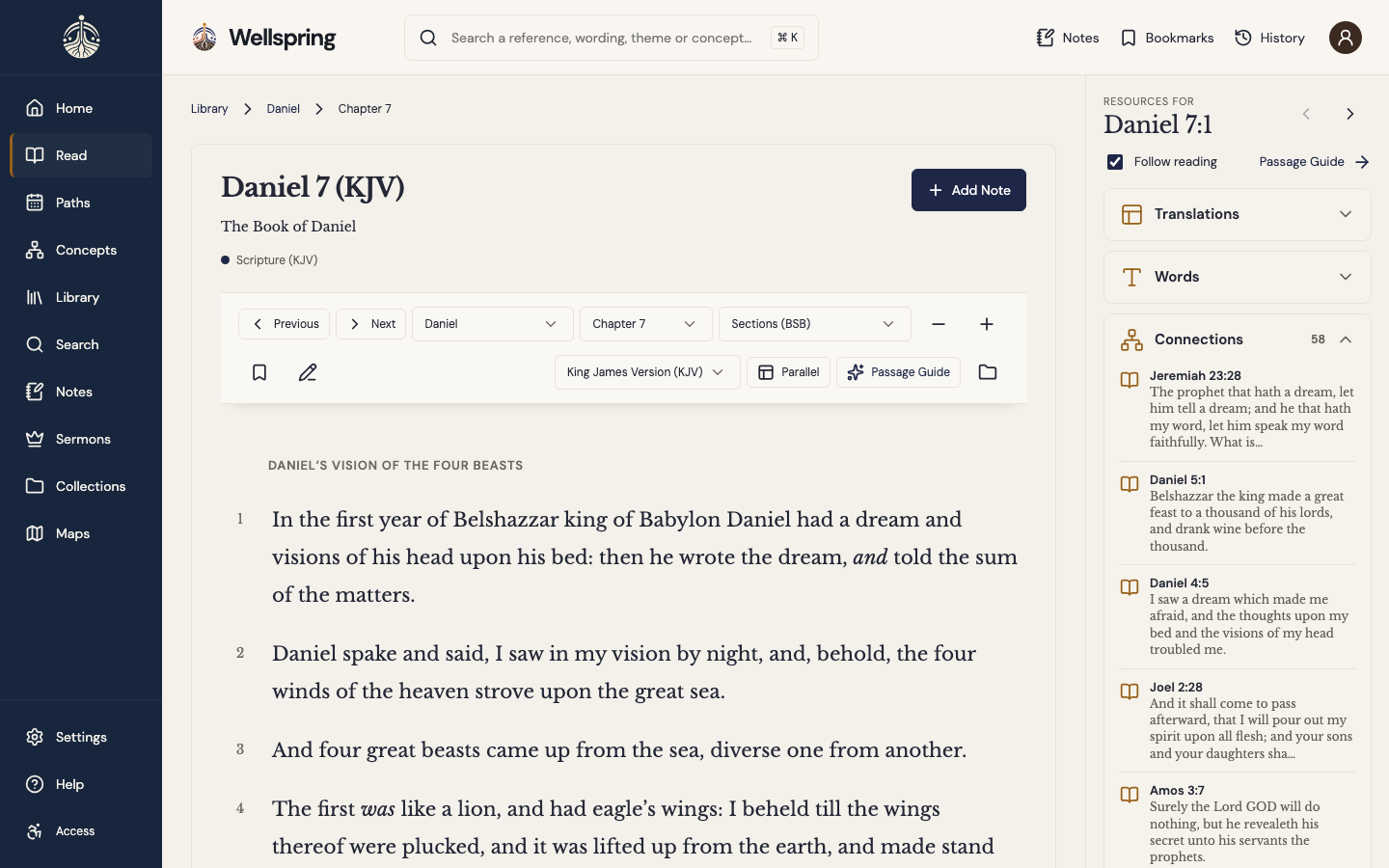
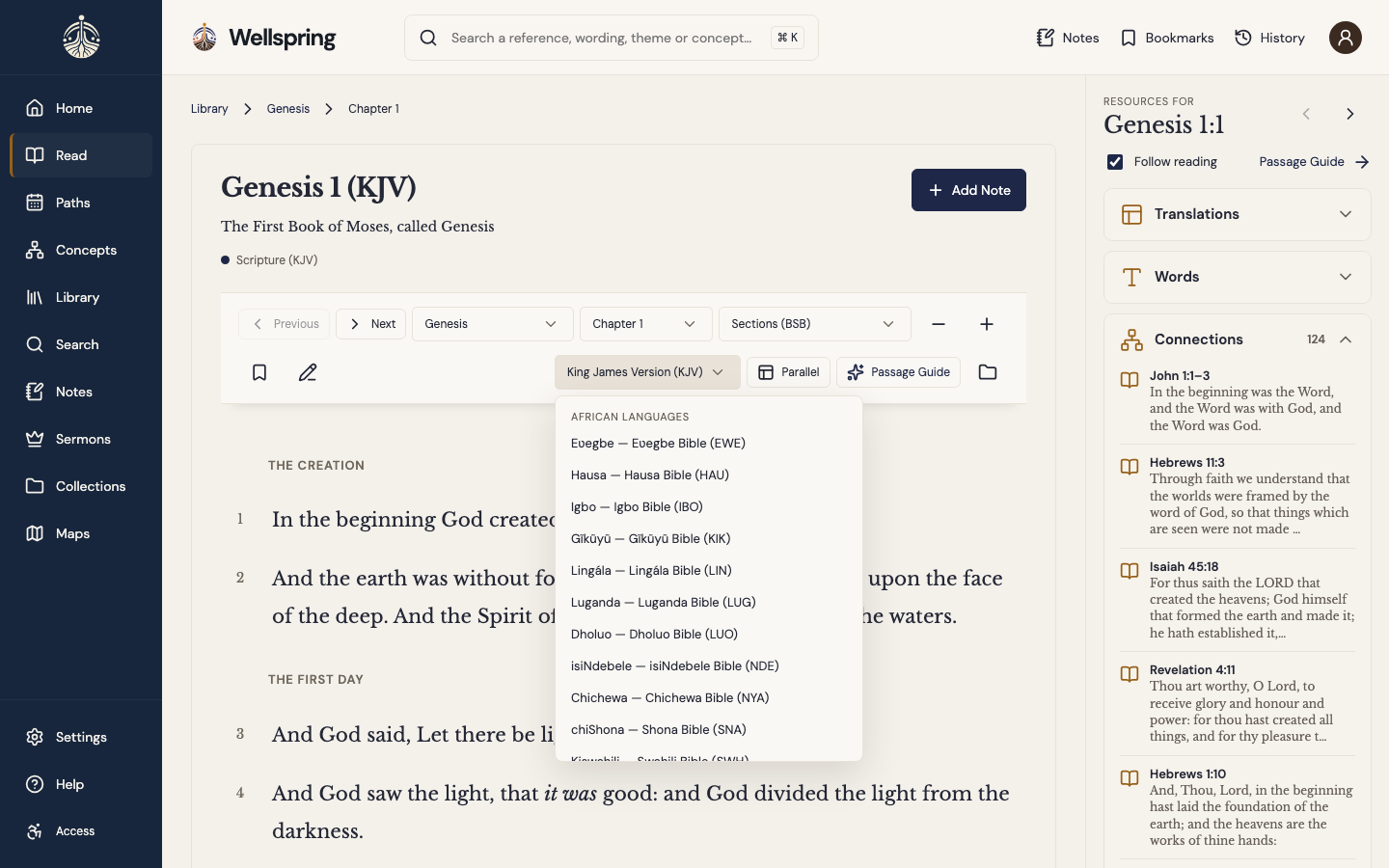
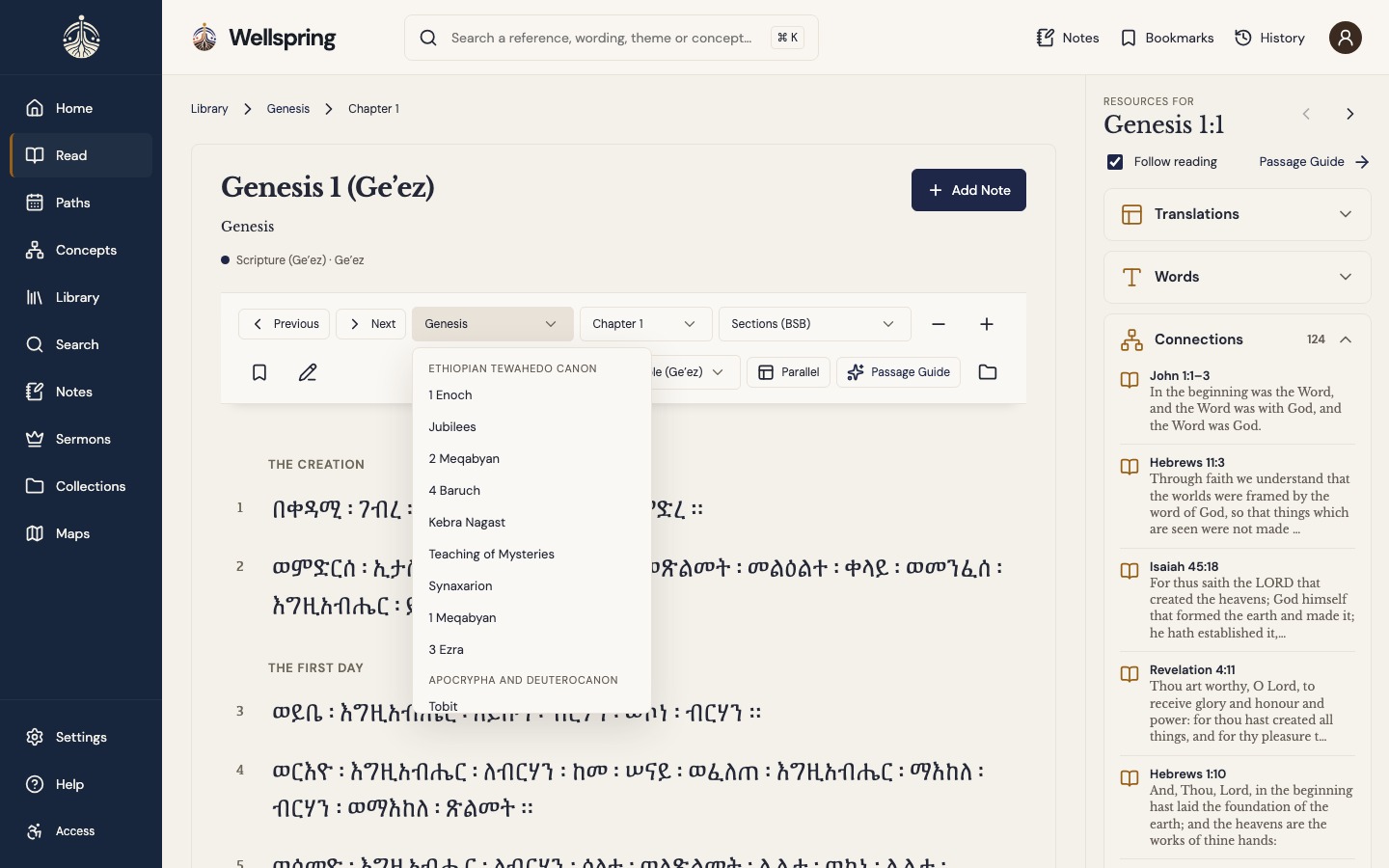
- Parallel reading
- Two or more translations verse by verse — Hebrew, Greek, the Septuagint, the Vulgate, the Coptic Bibles, or a Bible in Hausa, Igbo, isiNdebele, chiShona, Kiswahili, Twi or Yorùbá beside your own. Right-to-left scripts run the right way; the layout is remembered per chapter.
- The languages
- The Hebrew Bible and Greek New Testament with Strong’s numbers; the Sahidic and Bohairic Coptic Bibles as the African witness shelf; Bibles in fourteen African languages. Concept names lead in the language you choose.
- The names of the Most High
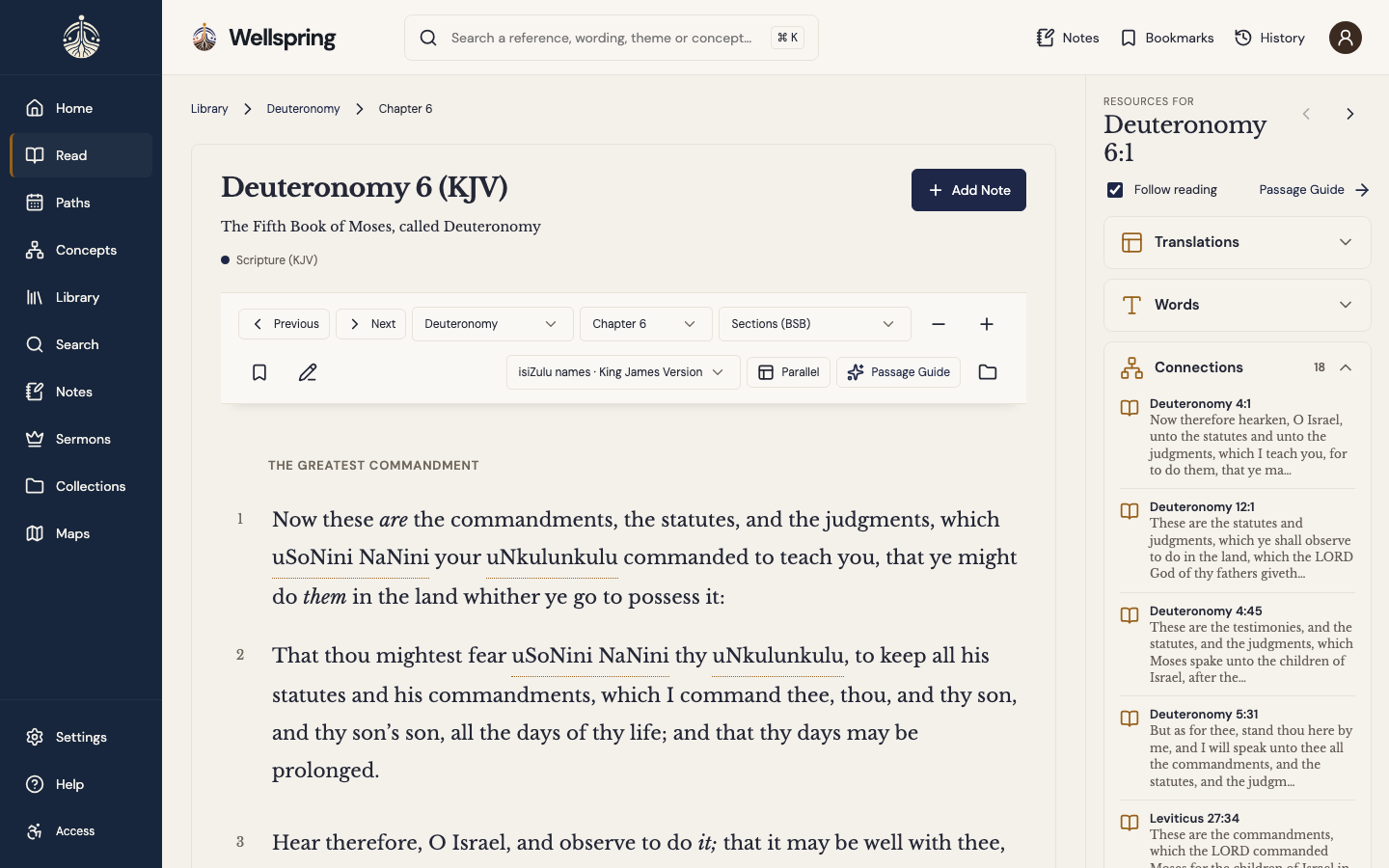
- An optional layer that renders the divine names in isiZulu over an English text — uSoNini NaNini for the personal name, uNkulunkulu where the translators capitalised God. Each rendering names the Hebrew lemma it stands for, and only lemmas with a sourced term are touched; “gods” stays “gods”. It is a way of reading a translation, listed apart from the translations themselves.
- Highlights and notes in place
- Select a verse to highlight it or write a note; both stay anchored to that verse and travel with it into your research.
- Where you left off
- The reader keeps your place chapter by chapter and book by book, so a chapter you have read is marked and the next one is a tap away. Home keeps a study rhythm beside it — the days you opened a text this week, and how many in a row. It records what you did; nothing is scored, nothing is locked behind it, and breaking it costs you nothing.
- Paths
- A commitment to read, one day at a time: a book of your Bible in its own order, or what Scripture says on a matter — anger, grief, marriage, work — walked heading by heading through the topical index. The text itself, no devotional written for you; your reflection is your own note. Home shows today’s reading and today’s Psalm.
Research
Follow the evidence — and see where it stops.
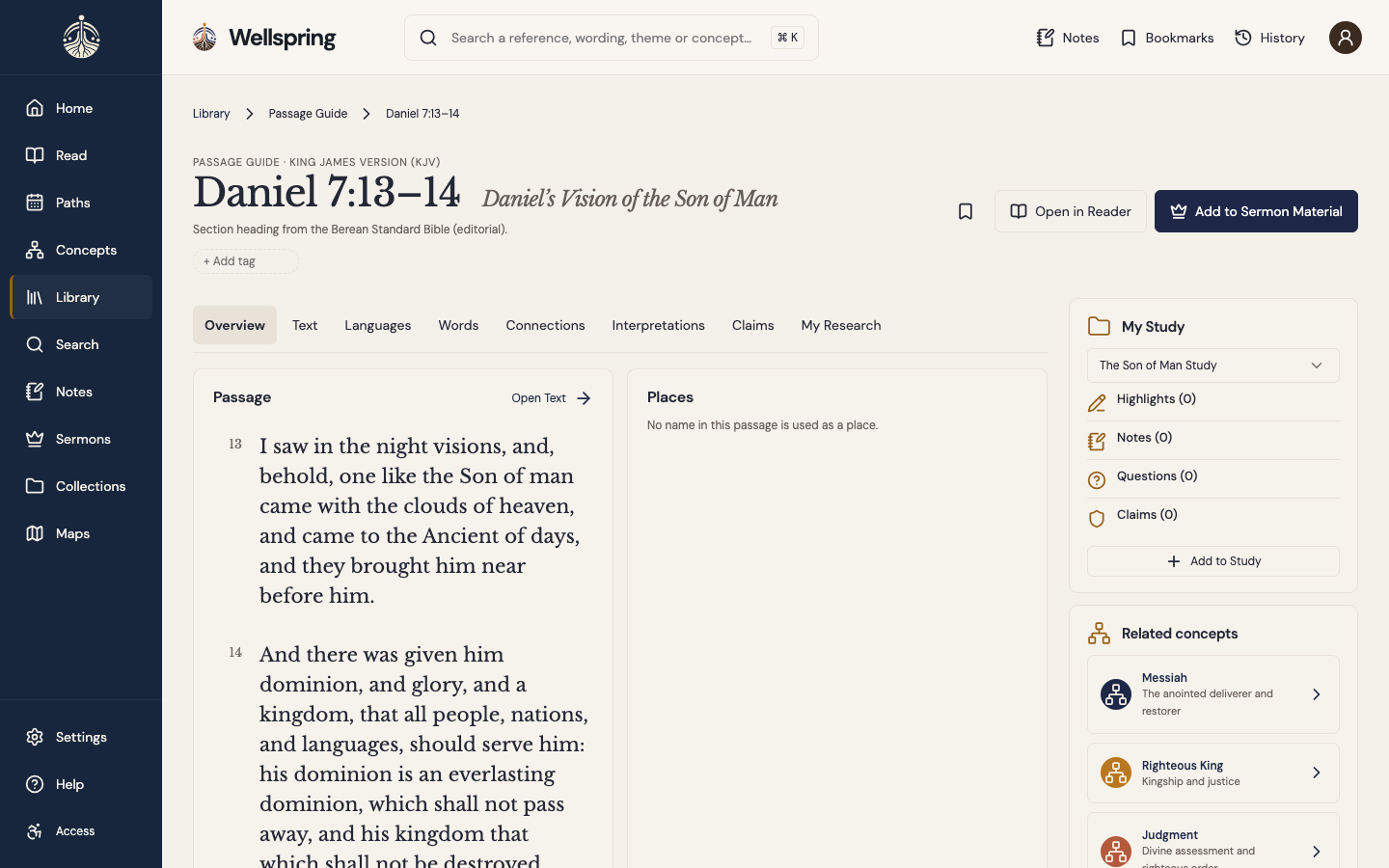
A Passage Guide that puts everything held about one passage on one page; every word linked to its lexicon entry and every occurrence; 3,623 concepts computed from public-domain indexes, most carrying their Hebrew and Greek; every place Scripture names on a map; the peoples whose history touches the biblical world. Evidence is shown as evidence; nothing is an interpretation until a framework is named.
- Word study and concordance
- From a word to its Strong’s entry, its gloss, how the King James renders it, and every place it appears — in context.
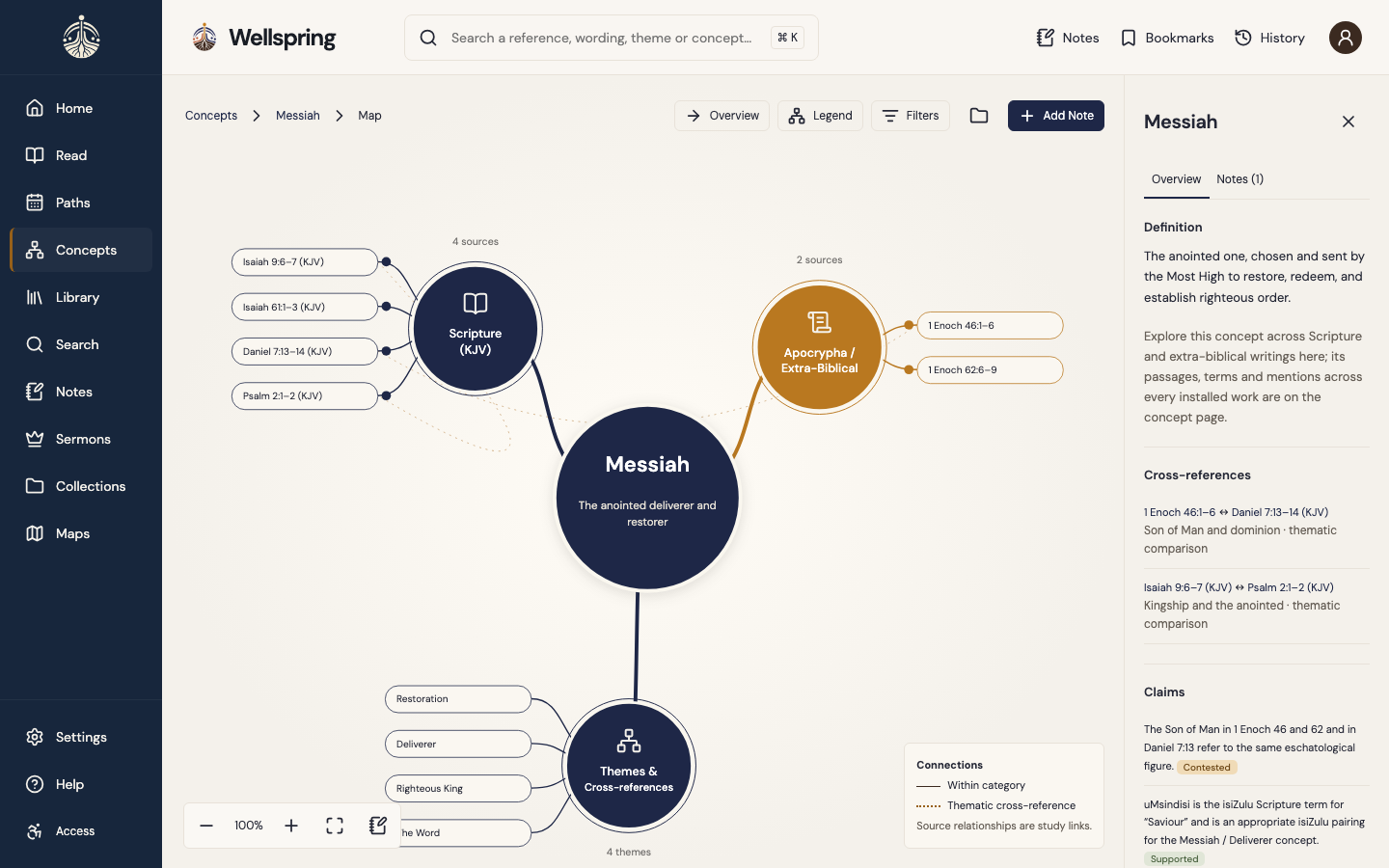
- Concepts and the map
- Each concept with its passages, its Hebrew and Greek where the King James tags supply them, its related concepts typed by the evidence that relates them, and every held work that mentions it. A glossary of 190 words across 10 African languages: for each concept, the word that Bible uses in the verses where the King James carries a given Hebrew or Greek lemma — measured, then confirmed against a lexicon outside that Bible before it was published. What measured well and could not be sourced is recorded as refused, with the reason.
- Atlas
- Every place Scripture names, scaled by how often, with the verses that name it. An identification carries its precision; a location is never a claim about who a people are.
- Peoples
- Research dossiers on communities whose history touches the biblical world — claims with typed evidence, named frameworks and counterclaims. Genetic evidence is never presented as identity.
- The library
- The canon and the Apocrypha; 1 Enoch and the Kebra Nagast; the Book of the Dead and the Qurʾan; Callaway’s Amazulu and Chatelain’s Angolan tales read in full; Philo, the Fathers, Calvin, Matthew Henry; the dictionaries and topical indexes. Every work with its provenance, its rights and its known limits. Inclusion is not endorsement.
Prepare
Learn to prepare a sermon. Write every word yourself.
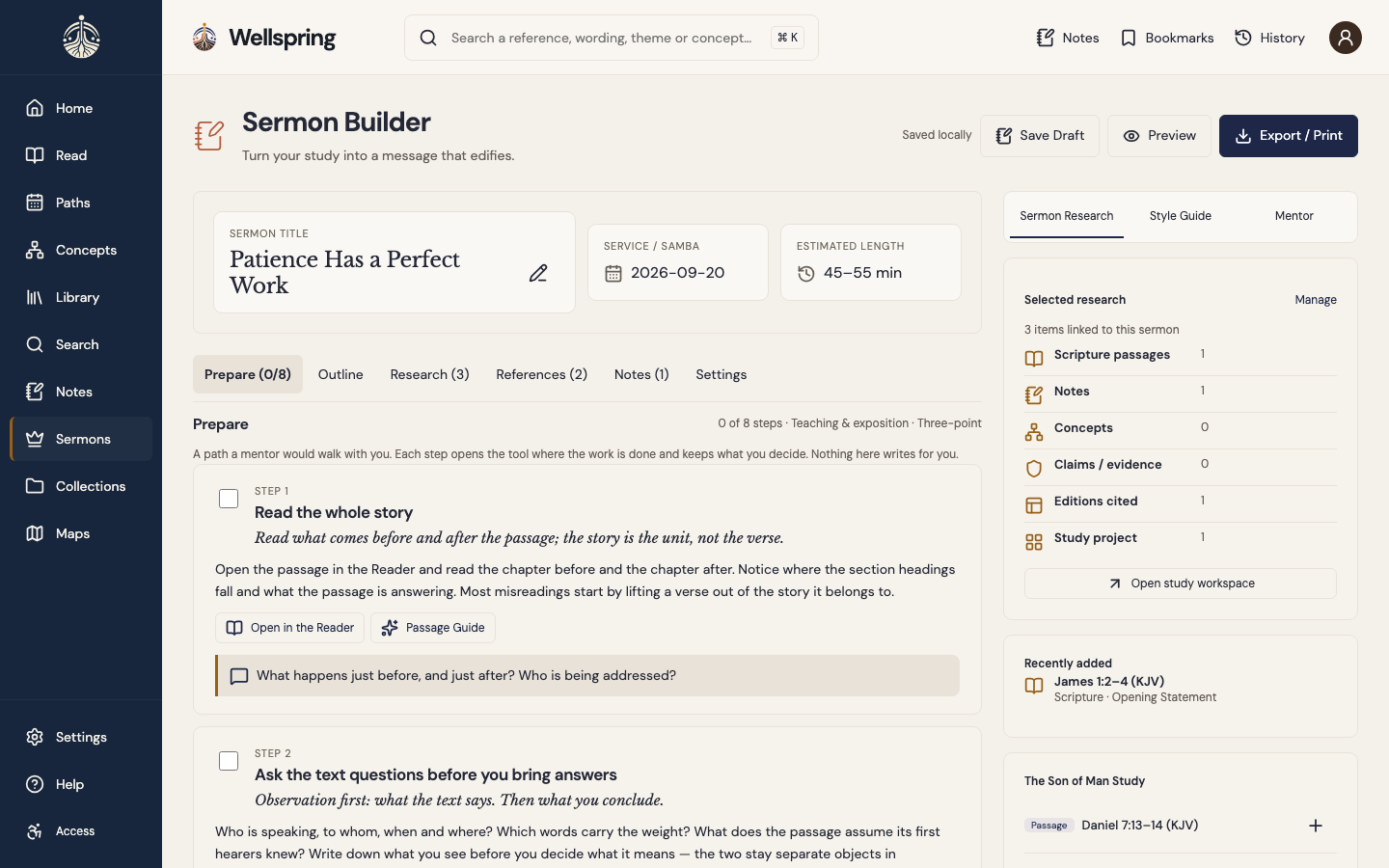
Eight guided steps — the passage and its context, your subject in one sentence, the kind of sermon, its form, the evidence it needs, the read-through — each with the rule, the reason, the tool and the question a mentor would ask. Sections are never locked. Nothing is ever written for you.
- Kinds, forms and evidence
- The kinds of sermon and what each needs; ten named forms with what each section must do, attributed to the teachers who described them; nine kinds of evidence — including African-language witnesses beside Hebrew and Greek — with when they are needed and how to say them aloud.
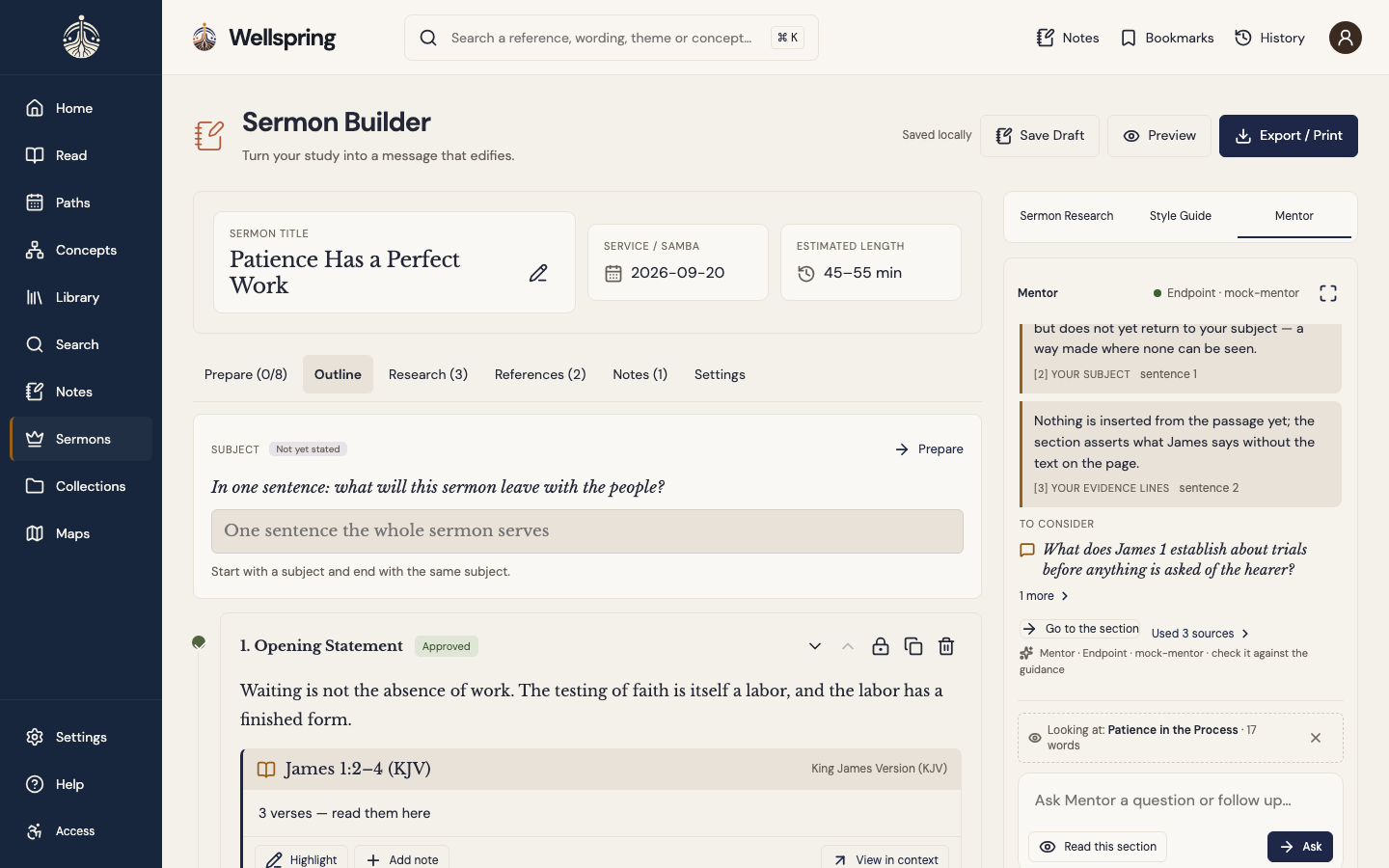
- The mentor
- An optional study assistant that reads a section of your draft against the guidance for its kind and form and answers with observations and questions. Nothing it says can be inserted into a section. It runs on your own device, free.
- A plain-language field guide
- Exegesis, proposition, the turn, application — every term a seminary would teach, explained for the minister who never went.
Keep
Your research stays yours.
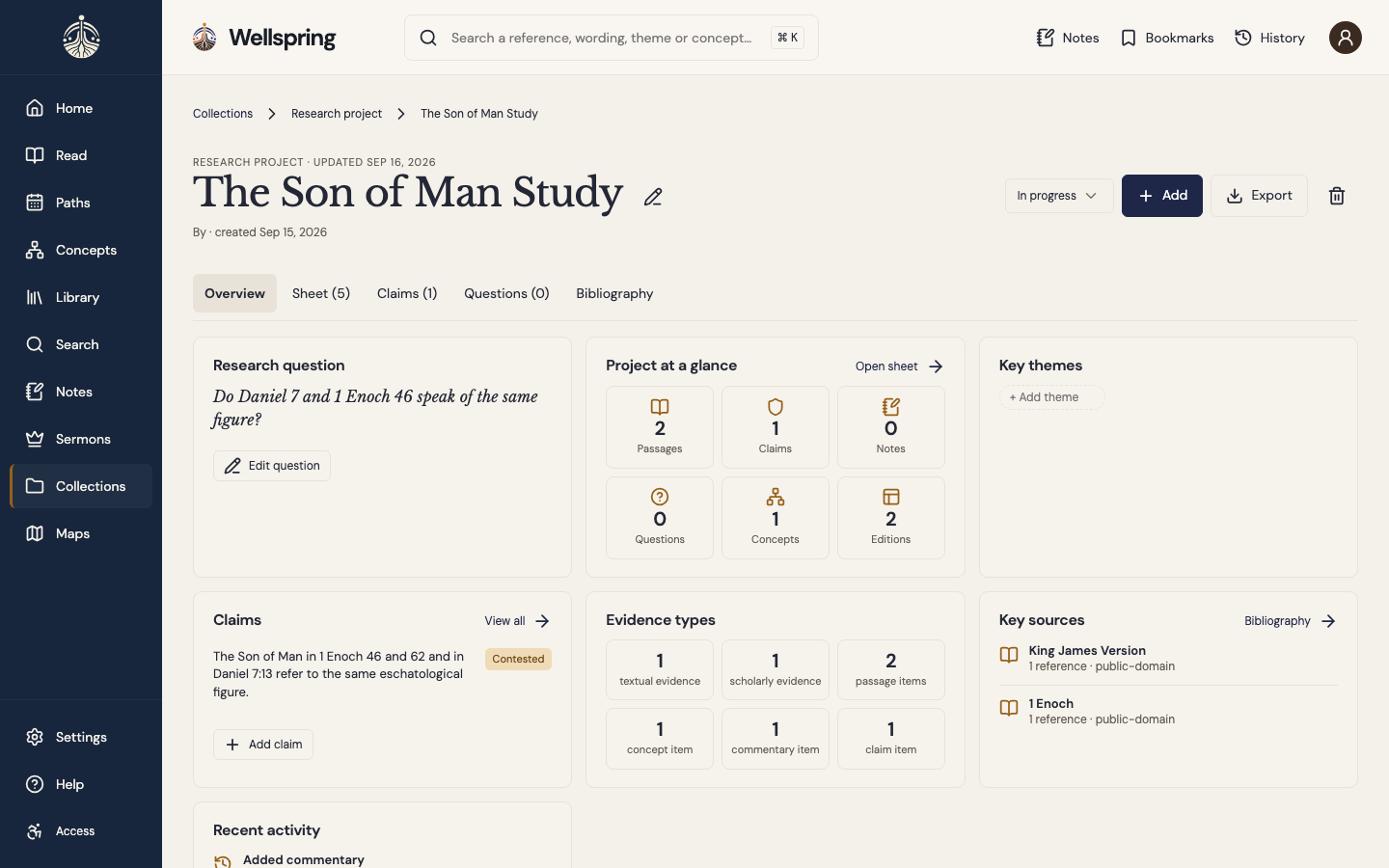
Notes travel with the verse or work they came from. Collections hold a question, a sheet of passages, words, concepts and notes, and the claims you test against them — evidence and interpretation as different objects, never blurred. A free account carries all of it between devices.
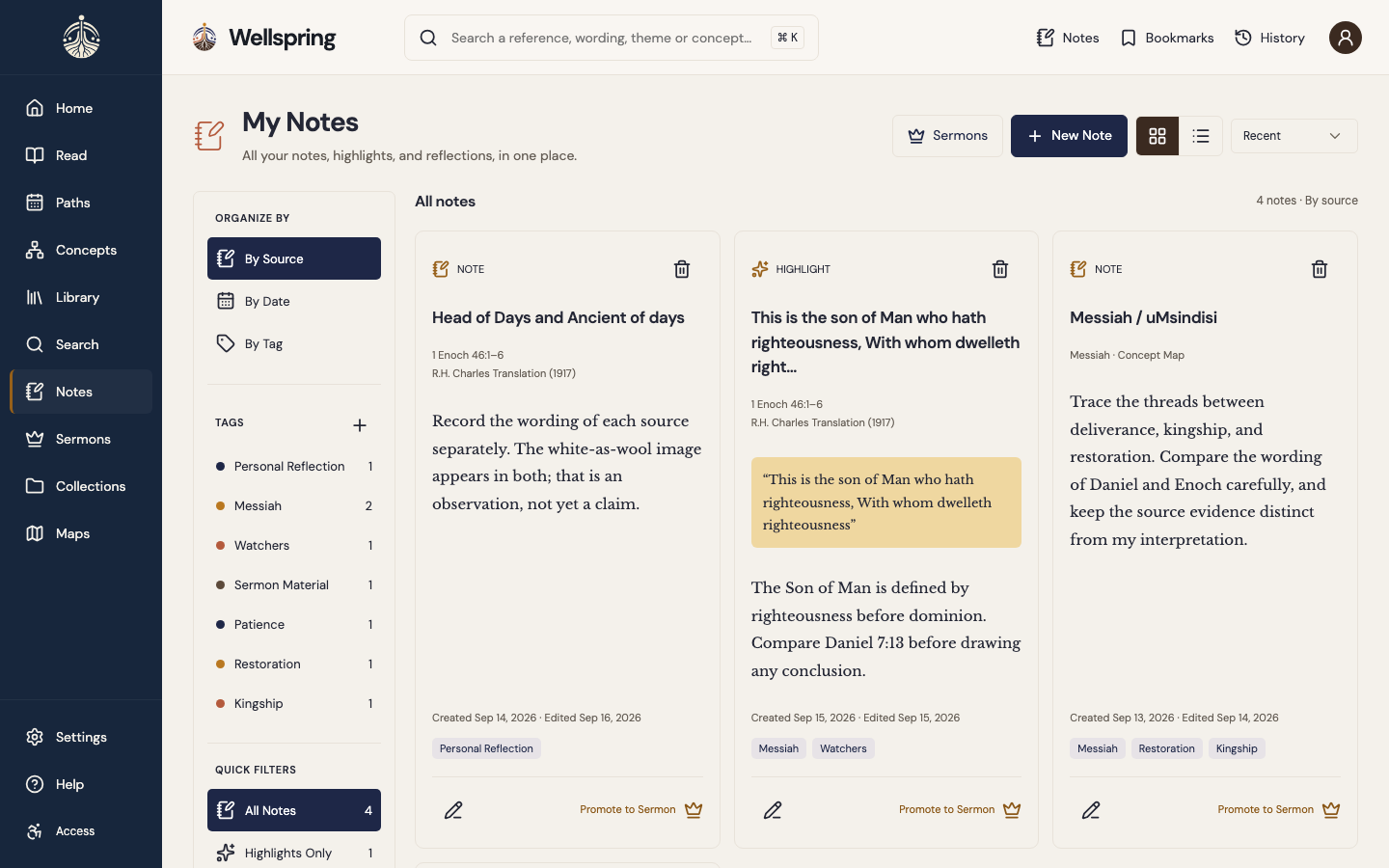
- Notes and highlights
- Tagged, grouped by source, date or tag, and marked as sermon material when you are ready.
- Collections and claims
- Claims with typed evidence, interpretations that name their framework, counterclaims, and your own assessment.
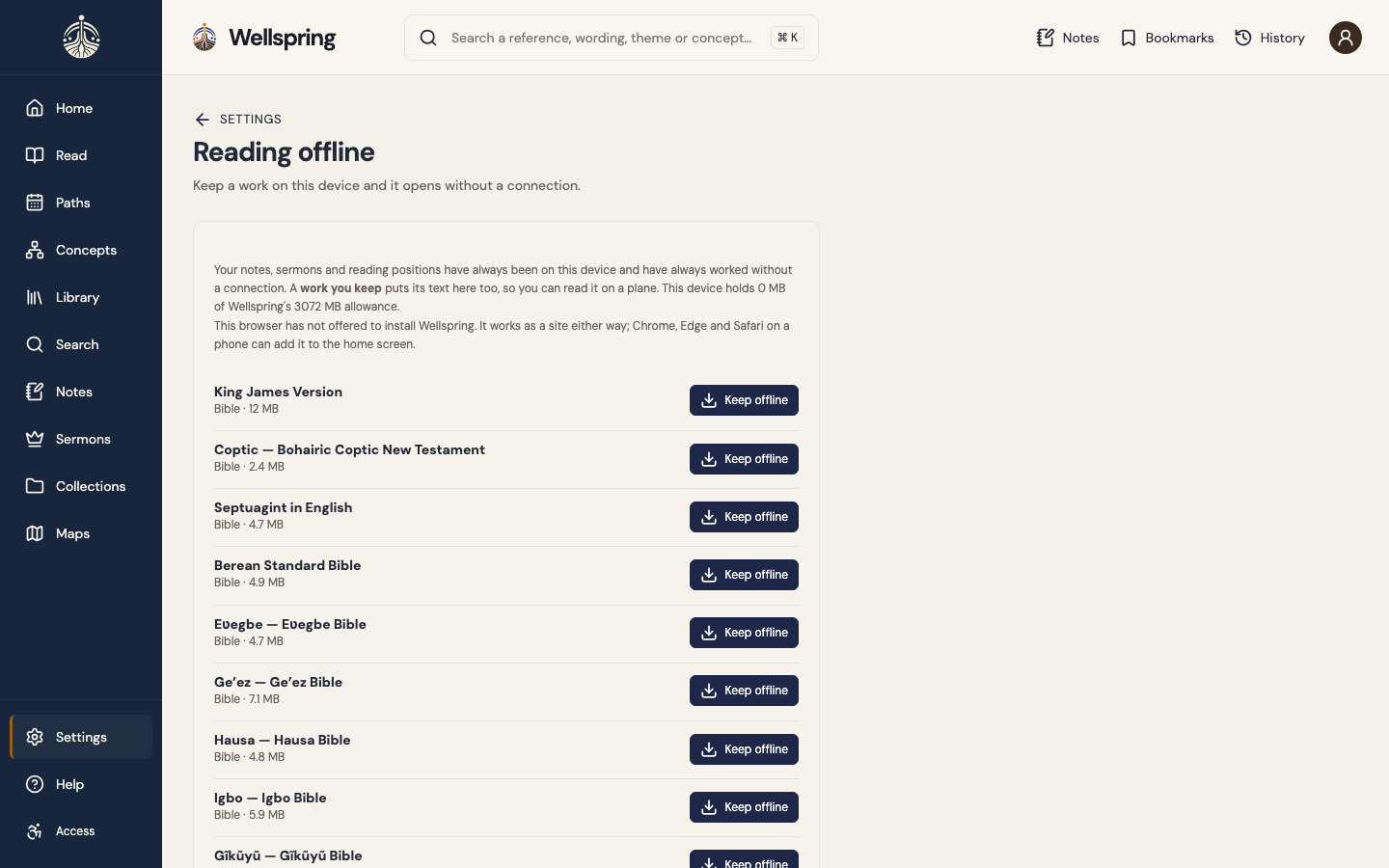
- Reading offline
- Keep a translation or a work on the device and it opens with no connection at all — on a plane, in a building with no signal, on a phone with no data left. You choose what to keep and you can free it again; nothing is downloaded behind your back.
- Your data, your device
- Export everything as a plain file; delete it with one control; no analytics, no ads, no paywall. The free account exists so your work follows you and stays yours on a shared computer.
Everything included
Nothing sold separately.
The free account includes every tool and every text below. Where a work is missing, the reason is written in the corpus register, not hidden.
- Reader with a verse-following resource panel
- Parallel translations, verse by verse
- Highlights and anchored notes
- Hebrew and Greek with Strong’s numbers
- Septuagint and Vulgate as witnesses
- Sahidic and Bohairic Coptic Bibles
- Bibles in Hausa, Igbo, isiNdebele, chiShona, Kiswahili, Twi, Yorùbá
- Word study and concordance
- Passage Guide
- 3,623 computed concepts, 2,746 with their Hebrew and Greek
- Concept map
- Atlas of every place Scripture names
- Peoples dossiers
- Library with provenance and rights on every work
- Topical indexes (Nave’s, Torrey’s)
- Bible dictionaries (Easton’s, Smith’s, ISBE, Schaff’s)
- Commentaries (Matthew Henry, Calvin on Genesis)
- The Fathers, Philo, the Councils
- Extra-biblical and comparative texts
- Oral-tradition archives read in full
- Collections and claims
- Guided sermon preparation
- Sermon kinds, forms and evidence
- Homiletics manuals (Broadus, Brooks, Spurgeon)
- The mentor, on your device
- Reading positions and study layouts
- Export, import and delete of all your research
- A free account, sync across devices